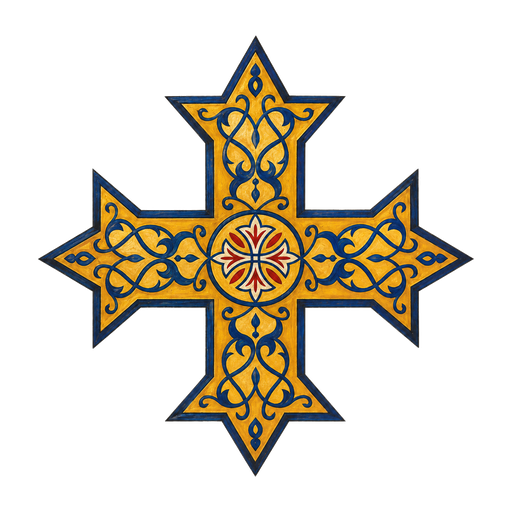
Beliefs and Tradition
What does “Coptic” mean?
Coptic means Egyptian, but in the Church it means more than ancestry. It names the Christian tradition of Egypt rooted in the preaching of St. Mark in Alexandria: the Church of Alexandria, her language, martyrs, monks, hymns, fasts, icons, and liturgical life.
Egypt And The Church Of Alexandria
The word Coptic carries a real historical inheritance. Christianity entered Egypt early, and the Coptic Orthodox Church remembers St. Mark the Evangelist as the apostolic founder of the Church of Alexandria. That makes the word Coptic a Church word before it is a cultural label.
Now a certain Jew named Apollos, born at Alexandria, an eloquent man and mighty in the Scriptures, came to Ephesus.
This history matters because Christianity is lived in real places, languages, families, and worshiping communities. In Egypt, the apostolic faith took root in a Church shaped by Scripture, the Liturgy, the desert fathers and mothers, and the witness of the martyrs.
The Language Of Worship
Coptic is also the final stage of the ancient Egyptian language, written with Greek letters and additional Demotic signs. In church life, Coptic remains a liturgical language. Even when much of the service is prayed in English or Arabic, Coptic hymns and responses preserve a memory of worship received across generations.
The goal of preserving Coptic is continuity. The inherited language reminds the faithful that worship was received before the present generation arrived, and that every parish is joined to a much older prayer.
Christian Identity Before Ethnic Identity
The Egyptian inheritance should be honored, but the heart of Coptic identity is Christ. The Church of Alexandria belongs to the Lord, not to one ethnicity. A person does not need to become Egyptian in order to enter the Coptic Orthodox Church. The deeper invitation is to receive the faith the Church has preserved: the Holy Trinity, the Incarnation, the Scriptures, the Holy Mysteries, the saints, repentance, and communion with Christ.
To say Coptic faithfully is to speak of an apostolic Church that remembers Egypt so that she can confess Christ clearly in every place where her children now live.
- The Coptic Orthodox Church, Coptic Orthodox Diocese of the Southern United States. Diocesan overview of the Coptic Church, her apostolic roots, and life of faith.
- History of the Coptic Orthodox Church, Coptic Orthodox Diocese of the Southern United States. Overview of the Church of Alexandria, St. Mark, and Coptic Christian history.
- Saint Mark, Coptic Orthodox Diocese of the Southern United States. Diocesan introduction to St. Mark the Evangelist and the apostolic foundation of the Church of Alexandria.
- Holy Tradition, Coptic Orthodox Diocese of the Southern United States. Explanation of Holy Tradition as the received apostolic life of the Church.
- Martyrdom, Coptic Orthodox Diocese of the Southern United States. Diocesan overview of martyrdom in the history and spirituality of the Church.
Icon: A sacred image of Christ, St. Mary, an angel, a saint, or a holy event. In Coptic practice, church icons are consecrated with Holy Myron and are venerated, not worshiped.
Orthodox: Right worship and right belief, naming the Church's received apostolic faith and the life of worship that preserves it.
Holy Trinity: The one God confessed as Father, Son, and Holy Spirit, one essence and three Persons, worshiped and glorified together.
Incarnation: The mystery that the eternal Word of God truly became man for our salvation while remaining fully divine.
Mysteries: The Orthodox name for the sacraments, calling attention to God's grace given through visible rites such as Baptism, Chrismation, Confession, and the Eucharist.
Holy Communion: The faithful receiving the true Body and Blood of Christ in the Eucharist, after baptismal life, repentance, confession, fasting, reconciliation, and pastoral preparation.